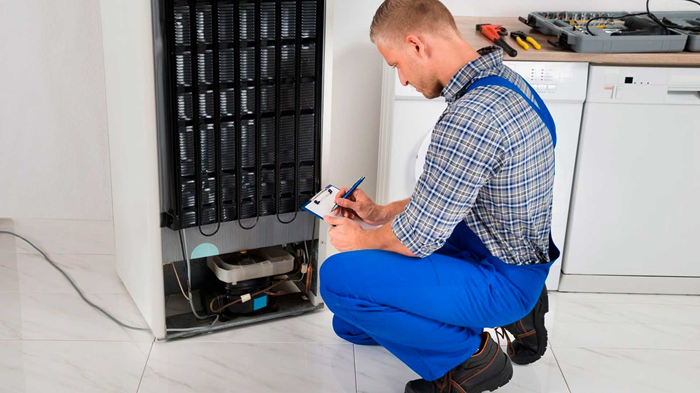
Commercial refrigeration equipment operates under increased loads: long cycles, frequent door openings, unstable room temperatures, high humidity, and demands for constant readiness.
Therefore, repairs here are not a one-time part replacement, but a precise diagnosis that takes into account technological processes, product range, and sanitary standards.
The key feature of service work is minimizing downtime and maintaining product quality. Misconfiguration of thermostatic valves, refrigerant selection, or circuit seal restoration can lead to repeated breakdowns, excessive energy consumption, and product damage, resulting in direct financial losses.
Diagnostics and Repair: Important Details
Repair of commercial refrigeration equipment begins with recording operating conditions and system behavior: temperature, ramp-up time, cycles, icing, noise, and vibration. Next comes an instrumental check: pressure, currents, overheating and subcooling temperatures, the condition of the filter-drier and the quality of heat exchange.
Work procedure that reduces the risk of recurrence
- Inspection and survey: what has changed in operation, were there any power outages, equipment movements, or changes in load.
- Heat exchange check: condenser cleanliness, fan operation, air flow direction, presence of hot air recirculation.
- Refrigeration circuit inspection: leak detection, pressure and piping temperature assessment, foaming and vibration damper check.
- Automation diagnostics: sensor readings accuracy, controller settings, relay and protection operability.
- Repair and restoration of tightness: soldering/replacement of components, mandatory pressure testing, vacuuming, correct charging.
- Commissioning: superheat adjustment, defrost check, energy consumption and temperature stability monitoring.
Refrigerant, oil and Circuit Cleanliness
During repairs, maintaining refrigerant and oil compatibility, as well as system cleanliness, is critical. Contamination with moisture or oil decomposition products can cause repeated clogging of the expansion valve/capillary, acidity, and accelerated compressor wear. After opening the circuit, filter drier replacement, deep vacuuming, and vacuum maintenance monitoring are usually required.
Speed of Repair and Food Safety
In retail and food service, a balance between rapid restoration and process accuracy is important. Temporary solutions are only acceptable as part of a plan that does not compromise safety: transferring products to backup chambers, using temperature loggers, and recording the time of departure from the permissible range. If the service is performed by a cold commercial company, it is useful to agree in advance on emergency response procedures, the availability of standard spare parts, and a procedure for documenting the work for internal control.
Prevention is often cheaper than repair: regular condenser cleaning, seal inspection, drainage checks, proper loading, and periodic pressure and temperature diagnostics. This approach reduces the likelihood of breakdowns, extends compressor life, and ensures stable storage conditions.
Which components fail most often and how to recognize their symptoms
In commercial refrigeration equipment, breakdowns most often involve components that operate continuously, experience high loads, and depend on the quality of the power supply, ventilation, and regular maintenance. Early recognition of symptoms helps prevent product damage and costly repairs.
Below are the most common “weak points” and signs that may indicate a malfunction before the system completely shuts down. If any abnormality occurs, it is important to record the symptoms (noise, temperature, icing, operating time) and promptly seek diagnosis.
Common Malfunctions: Component and Characteristic Symptoms
- Constant compressor operation most often indicates poor heat dissipation (dirty condenser), refrigerant leakage, air suction through seals, or fan problems.
- Icing up of the evaporator is most often associated with a defrost failure, weak airflow, or incorrect refrigerant dosing/supply.
- Extraneous noise is often caused by the fan (bearings/impeller), while a dull thumping sound and overheating are signs of compressor problems.
- Water in the chamber almost always indicates a drainage problem or an incorrect defrost mode.
Summary: the most common components that fail are those responsible for circulation and heat exchange (compressor, fans, condenser/evaporator), as well as control and defrost elements (controller, sensors, heating element). Symptoms typically include rising temperatures, freezing, continuous operation, noise, water leaks, and erratic cycles. The sooner you identify the signs and diagnose them, the better the chance of getting a low-cost repair without downtime or product loss.