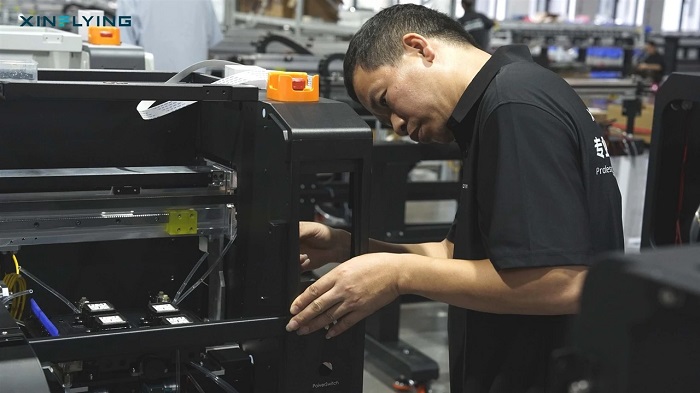
When commercial print shops experience missing nozzles, horizontal banding, or premature printhead replacement on a roll-to-roll UV DTF (ultraviolet direct-to-film) printer, the primary mechanical trigger is almost always titanium-dioxide white pigment settling combined with cured UV ink build-up along the capping station rim and wiper blade.
Because a UV DTF line jets white underbase, CMYK colour, and clear UV varnish simultaneously inches away from high-intensity UV LED lamps, establishing a disciplined white-ink agitation and cap-station cleaning routine is the single most effective way to protect printhead investment.
Why White UV Ink and Scattered UV Light Create Unique Clogging Risks
In a roll-to-roll UV DTF system, two physical hazards operate side by side every time the carriage moves across the A-film web. First, white UV ink relies on heavy titanium-dioxide particles to deliver opaque coverage over dark glass, metal, and rigid packaging. Unlike dissolved dye molecules in CMYK channels, suspended white pigment particles naturally settle toward the bottom of ink sub-tanks, damper filters, and manifold channels whenever fluid flow stops.
Second, UV-curable ink cross-links the moment it encounters stray ultraviolet photons:
- Reflected UV LED light off glossy A-film: If the printhead carriage gap sits unnecessarily high above the glossy release film, stray UV reflections can partially polymerise microscopic ink mist clinging to the nozzle plate face.
- Hardened ink crust on cap-top rubber lips: When dried UV ink builds up on the perimeter of the capping station rubber seals, the cap can no longer form an airtight vacuum seal when the carriage parks overnight, allowing air and stray room light to reach the nozzles.
- Contaminated wiper blades smearing varnish across channels: A wiper blade coated with sticky clear varnish drags partially cured resin directly across adjacent white and CMYK nozzle rows during automated cleaning cycles.
Scheduled Maintenance Matrix for Commercial Roll-to-Roll UV DTF Printheads
Print shops that run UV DTF machines for years without unscheduled head replacements divide printhead maintenance into three strict time intervals rather than waiting for visible banding on a customer job.
| Maintenance Interval | Target Component on the UV DTF Line | Required Operator Action | Technical Failure Prevented |
|---|---|---|---|
| Daily Shift Start (Before First Job) | White ink circulation path & nozzle test strip | Verify active white-ink tank agitation/circulation; print a single nozzle check pattern on A-film before nesting jobs | Detects single deflected nozzles before wasting a full 60 cm nested gang sheet |
| Daily Shift End (Mandatory Shutdown Prep) | Wiper blade, cap-top rubber perimeter, & carriage bottom plate | Dip a lint-free foam swab in dedicated UV cleaning fluid to wipe cured mist off cap lips, wiper rubber, and head guard rails | Ensures an airtight cap seal overnight and stops reflected UV mist from hardening on the nozzle guard |
| Weekly Deep Check | Pinch rollers, encoder strip, & waste-ink drain tubes | Flush a small volume of UV cleaning fluid through cap-top drain lines so waste varnish does not solidify inside the pump tubing | Prevents clogged peristaltic pump lines and back-flooded capping stations |
| Multi-Day / Holiday Idle Window | Damper lines & parked printhead nozzles | Follow the manufacturer’s wet-capping or cleaning-solution flush protocol and leave main circulation power set per manual | Stops titanium-dioxide white ink from compacting into a dense cake inside the head manifold |
Three Shop-Floor Habits That Extend Piezo Printhead Lifespan
Beyond daily swabbing, three operational habits separate low-maintenance UV DTF rooms from shops plagued by morning nozzle dropouts.
First, never use ordinary rubbing alcohol (IPA) or aggressive acetone on UV printhead faces or capping rubber. Isopropyl alcohol reacts poorly with certain UV resin dispersions—causing instant gelation inside microscopic nozzle bores—while acetone swells and deforms rubber cap seals. Always use the dedicated UV flushing solution specified for your ink chemistry.
Second, keep the printhead carriage at its proper close gap over flat A-film. Because roll-to-roll UV DTF always prints onto uniform flat film rather than thick 3D objects, keeping the carriage at the standard film clearance minimises both ink misting and stray UV light reflection under the carriage.
Third, schedule at least a brief white-ink circulation and test print on non-production days if the machine is not flushed for long-term storage. Moving fresh white ink through the dampers for a few minutes prevents pigment stratification.
Selecting Industrial UV DTF Printers Built With Automated White-Ink Management
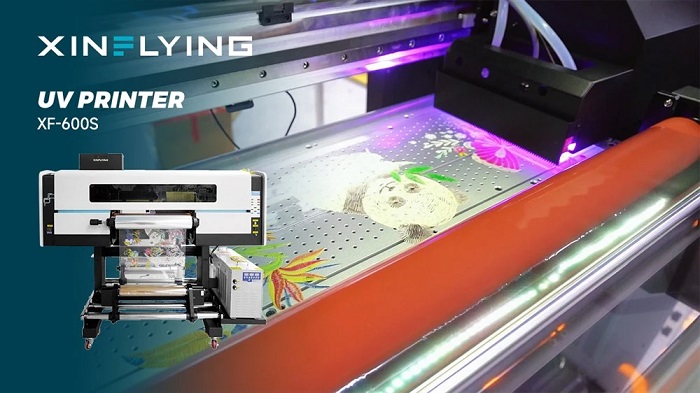
Hardware engineering plays a major role in reducing daily maintenance workload: industrial roll-to-roll machines equipped with automated white-ink stirring, closed-loop circulation, and accessible capping stations make shift-end care fast and predictable. Print shop managers evaluating four-head 60 cm industrial platforms such as the XINFLYING XF-600S—or comparing configurations like the XF-600, XF-600st, XF-450S, and XF-420S—can review the complete specifications across XINFLYING roll-to-roll UV DTF printer machines to inspect printhead architecture and ink-supply controls.
By pairing an industrial roll-to-roll platform like the XINFLYING XF-600S with ten minutes of daily cap-top and wiper care using dedicated UV cleaning fluid, commercial print shops can keep all white, colour, and varnish channels firing crisply year-round.